Service Request Form – Fill out form
Here you can access my service request form and provide information to begin the process today.
Service Request Form – Fill out form
Here you can access my service request form and provide information to begin the process today.
Serving the West Kootenay Boundary since 2016, Code’s CAD provides technical drawing services for things like building permit applications and construction projects.
Serving the West Kootenay Boundary since 2016, Code’s CAD provides technical drawing services for things like building permit applications and construction projects. I hold a diploma in Architectural Design & Technology through the Visual College of Art & Design in Vancouver and have 20+ years experience with steel fabrication design and detailing where I convert engineered or architectural drawings into “shop” or “construction” drawings so that fabrication shops and construction crews can build machines and structures.
My experience in custom fab, commercial transport, mining equipment, manufacturing, and electrical enclosures, provides you with excellent services in drafting and design. Give me a call to discuss your next project and discover what Code’s CAD can do for you. 250-584-4685 or email cody@codescad.ca.
Homeowners can utilize passive features in their homes to improve energy efficiency, reduce utility costs, and enhance overall comfort. Passive features rely on the design and natural elements of the home rather than mechanical systems. Here are some key strategies:
By incorporating these passive design strategies, homeowners can significantly enhance the sustainability and efficiency of their homes while creating a more comfortable living environment.
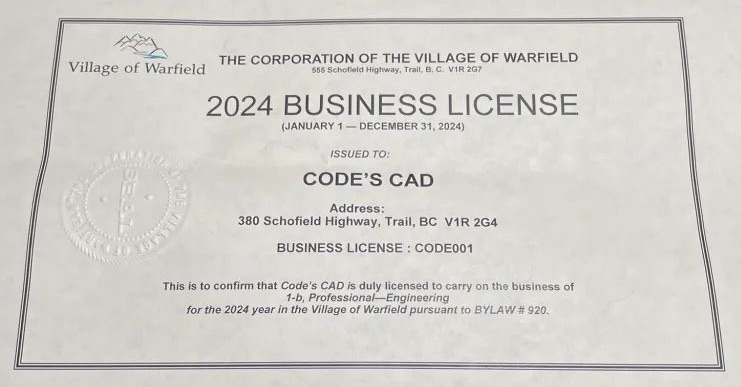
Code’s CAD is duly licensed to carry on the Business within the village of Warfield.
It’s a pleasure to work in such a beautiful remote location within British Columbia. Being surrounded by nature is a great place to work. The inspiration it brings to the design and the focus it provides is essential to providing a good service. Thank you, village of Warfield for allowing me to operate my business in such a beautiful place.
Cody Zorn, Code’s CAD
As of September 15th, 2023 Code’s CAD has joined the Boundary Country Regional Chamber of Commerce. By being a member of the local business organization, we hope to be able to offer more Residential, Commercial, and Industrial CAD services in the area.
As of September 15th, 2023 Code’s CAD has joined the Trail & District Chamber of Commerce. By being a member of the local business organization, we hope to be able to offer more Residential, Commercial, and Industrial CAD services in the area.

 CODE'S CAD
You must be logged in to post a comment.