Service Request Form – Fill out form
Here you can access my service request form and provide information to begin the process today.
Service Request Form – Fill out form
Here you can access my service request form and provide information to begin the process today.
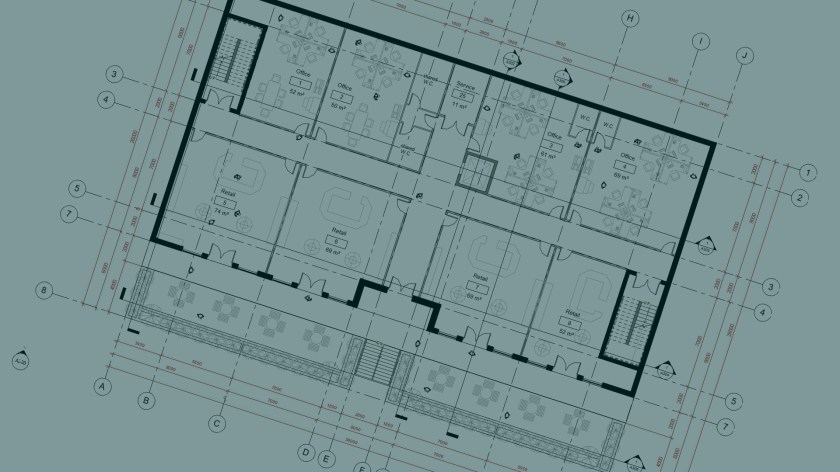
Whether you’re planning a renovation, an addition, or a brand‑new build, one of the most important steps in the process is having clear, accurate drawings. Even small projects can quickly become stressful or expensive without a solid plan in place. Professional drawings help homeowners feel confident, stay on budget, and ensure the end result matches their vision.
Here’s why they matter so much.
It’s not always easy to picture how a new room, layout, or addition will actually look. Professional drawings — especially 3D models — help you visualize the design long before construction starts.
They allow you to:
Seeing your project on paper (or in 3D) prevents surprises and helps you feel good about your choices.
Most residential projects require permits, and municipalities expect accurate, code‑compliant drawings as part of the application. Submitting clear drawings helps:
Good drawings mean you get to the building stage faster — without headaches.
Homeowners and contractors often imagine things differently unless they’re working from the same plan. Drawings make sure everyone is aligned.
They clarify:
This helps avoid common misunderstandings like wrong room sizes, misplaced windows, or layout changes that weren’t requested.
Changes made during construction are usually the most expensive part of any project. Drawings help you catch issues early — before anyone starts cutting lumber.
With proper drawings, homeowners can avoid:
A little planning upfront leads to big savings later.
When contractors have detailed drawings, they can price the job far more accurately. This helps you:
Drawings create transparency and set clear expectations for everyone involved.
Great design isn’t just about construction — it’s about how you live in the space every day. Drawings help ensure the final result feels right.
They contribute to:
Thoughtful design supports both comfort and creativity in the home.
Even after your project is complete, your drawings remain a valuable reference. They help with:
Good documentation grows in value over time.
For homeowners, investing in professional drawings is one of the smartest decisions you can make. They reduce stress, prevent costly mistakes, improve communication with your builder, and help turn your ideas into a home that feels exactly the way you imagined.
When you start with clear drawings, you’re starting with a strong foundation — and that leads to a better, smoother, and more enjoyable building experience.
Contact Code’s CAD today!
Code’s CAD is duly licensed to carry on the Business within the village of Warfield.
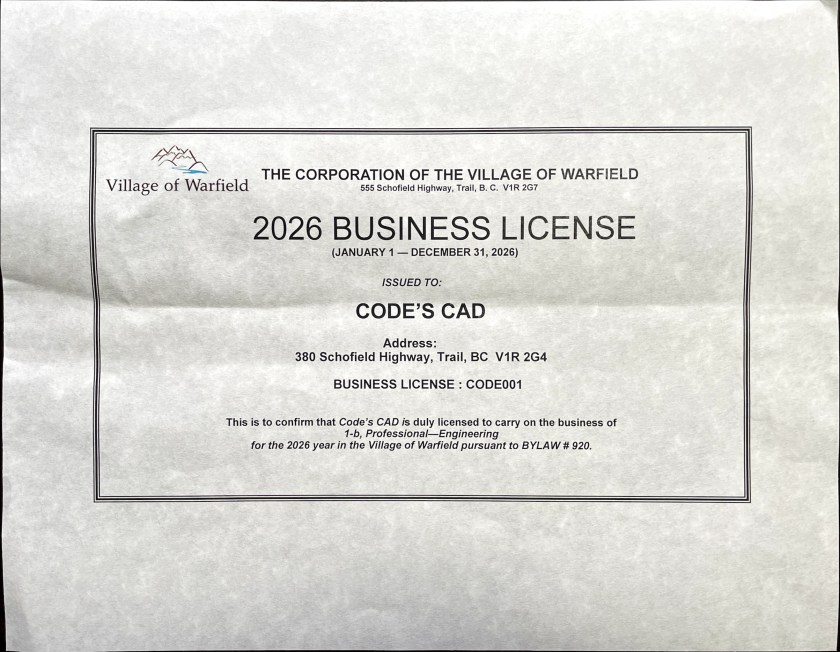
It’s a pleasure to work in such a beautiful remote location within British Columbia. Being surrounded by nature is a great place to work. The inspiration it brings to the design and the focus it provides is essential to providing a good service. Thank you, village of Warfield for allowing me to operate my business in such a beautiful place.
Serving the West Kootenay Boundary since 2016, Code’s CAD provides technical drawing services for things like building permit applications and construction projects.
Serving the West Kootenay Boundary since 2016, Code’s CAD provides technical drawing services for things like building permit applications and construction projects. I hold a diploma in Architectural Design & Technology through the Visual College of Art & Design in Vancouver and have 20+ years experience with steel fabrication design and detailing where I convert engineered or architectural drawings into “shop” or “construction” drawings so that fabrication shops and construction crews can build machines and structures.
My experience in custom fab, commercial transport, mining equipment, manufacturing, and electrical enclosures, provides you with excellent services in drafting and design. Give me a call to discuss your next project and discover what Code’s CAD can do for you. 250-584-4685 or email cody@codescad.ca.
Homeowners can utilize passive features in their homes to improve energy efficiency, reduce utility costs, and enhance overall comfort. Passive features rely on the design and natural elements of the home rather than mechanical systems. Here are some key strategies:
By incorporating these passive design strategies, homeowners can significantly enhance the sustainability and efficiency of their homes while creating a more comfortable living environment.
Code’s CAD is duly licensed to carry on the Business within the village of Warfield.
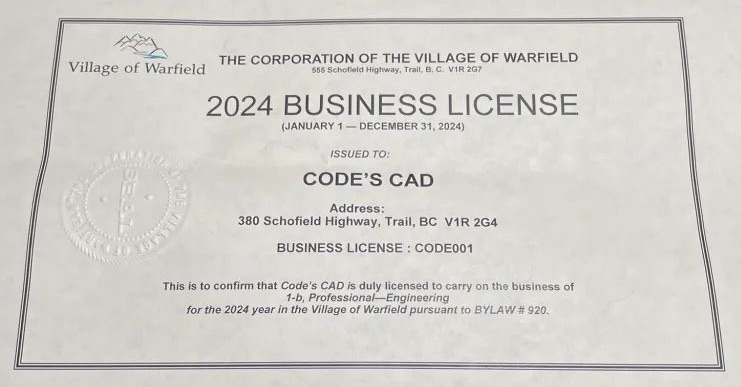
It’s a pleasure to work in such a beautiful remote location within British Columbia. Being surrounded by nature is a great place to work. The inspiration it brings to the design and the focus it provides is essential to providing a good service. Thank you, village of Warfield for allowing me to operate my business in such a beautiful place.
Cody Zorn, Code’s CAD
The 2024 International Codes® (I‑Codes®) have undergone substantial formatting changes as part of the digital transformation strategy of the International Code Council® to improve the user experience.
Starting with the launch of the 2024 I‑Codes and beyond, the I-Codes will align the print and PDF versions of the I‑Codes with the ICC’s Digital Codes® content.
The new 2024 International Building Code Updates are now released. Check them out here!

 CODE'S CAD
You must be logged in to post a comment.